Sunday, August 21, 2011

Tuscan Weekend Trip: Part Two

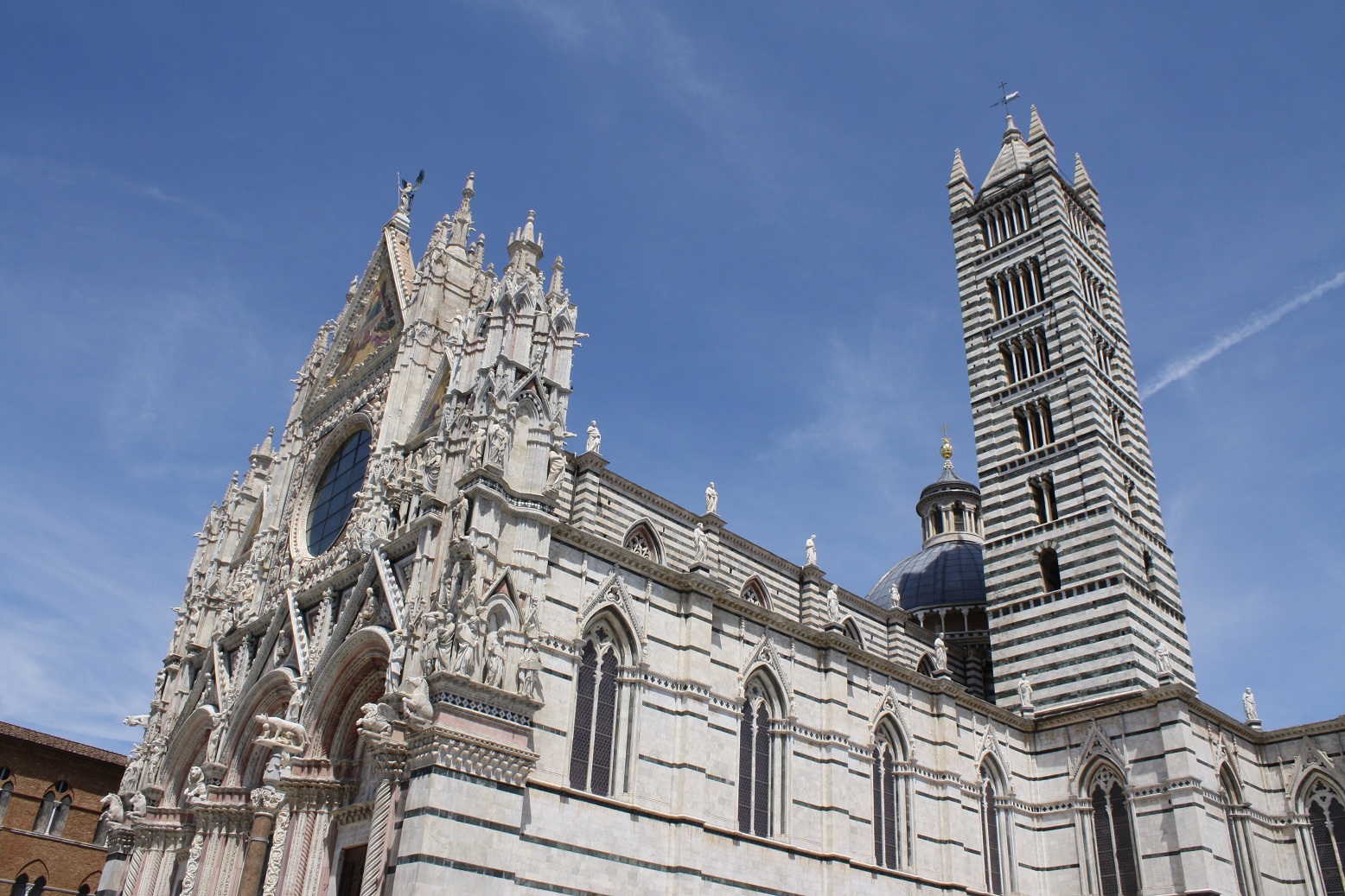
To begin the second half of our Tuscan weekend, we left Chianti and headed about an hour away, to a town called Siena. Siena is an ancient Tuscan town, and one of the most visited tourist locations in Italy. Siena has a beautiful gothic Duomo, which it is famous for, as well as a famous piazza - Piazza del Campo. These were our first two stops in the town.

Siena's Duomo


Inside the Duomo - facing the altar


 Looking up at the top of the dome


Piazza del Campo - famous for horse races held here twice a year


One thing I noticed about Siena as we first arrived and wandered up a very narrow and steep road (Side note: Siena is very hilly, with many steep inclines. You earn every calorie of your pizza/gelato when visitng here) was snails. Yep...snails. During our first few moments walking (panting) up the road, I spotted several lurking over doorways, mailboxes, walls, etc:  


We figured that the snail must be the mascot of Siena, or something similar. Then, a little while later, the snails became ducks.
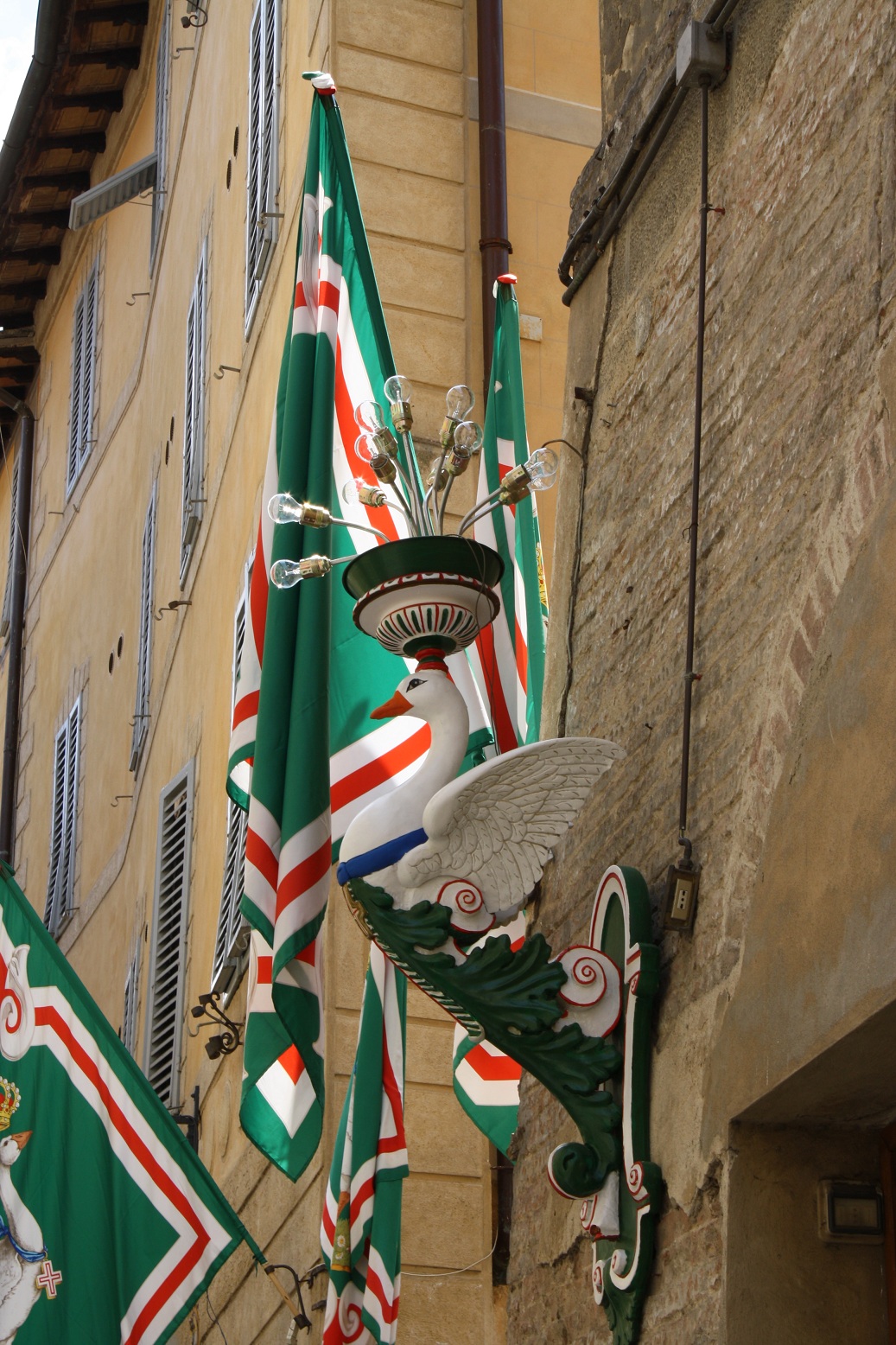


Then, as were were wandering through Piazza del Campo, we happened across a lively parade. Men dressed in medieval red suits waved flags and played an anthem of some sort on drums as they marched through the piazza. On closer inspection, the flags were adorned with...elephants!


Obviously, we were on to something...we just had no idea what. Upon arriving back home, I employed my best investigative skills (i.e. Wikipedia) to discover the reason behind the animal-centric look of Siena. I discovered that Siena is divided into 17 "contrade." A contrada (singular of contrade) is a district, or a ward, within an Italian city. Although the contrade were originally created in the Middle Ages for military purposes, they are now simply areas of "localized patriotism" held together by the civic pride of its residents. Every important life event for a Siena resident - births, deaths, baptisms, marriages, deaths, or holidays - is celebrated only within its own contrada. Each contrada has its own museum, fountain, allied contrada, and adversary contrada. What the adversary/ally thing means I am not sure...do they throw tomatoes at an adversary? Treat an ally to a coffee should they see one in the local bar? Would be interesting to know. My only guess is that it comes down to the Palio di Siena. The 17 contrade of Siena compete against one another every year, in a famous horse race held twice during the summer called the Palio di Siena. The race takes place in the Piazza del Campo and is the highlight of the year for residents of Siena.


Palio di Siena - Photo courtesy of Wikipedia

Each contrada also has a mascot or symbol - hence the snails, ducks and elephants we saw. The mascots are made up of: Eagle, caterpillar, snail, little owl, dragon, giraffe, crested porcupine, unicorn, she-wolf, seashell, goose, wave, panther, forest, tortoise, tower, and valley of the ram. Each one has a long and colorful history, and was chosen/established due to heraldic and semi-mythological associations.
If we go back to Siena, knowing what I know now, I will definitely be on the look out for more evidence of the contrade around the city. Yet another interesting bit of history in Italy I would never have known had I not stumbled right across it!

We ended our Tuscan weekend with a one-day stay in Florence. This was the second time we'd visited, and one thing we wished we'd have done during our previous trip was to fasten a padlock onto the Ponte Vecchio. It is a tradition in Florence for couples to visit this famous bridge. It is said to be good luck for a couple to write their names and the date of their visit on a padlock and fasten it on to the bridge, then throw the keys over the bridge and into the river. We noticed the locks on our last visit, but had no idea as to their signifigance. This time we, along with our honeymooning visitors, purchased locks and took part in the tradition said to bring luck in love to couples.


Last but not least, I could not end this blog on Tuscany without including one of Roland's biggest highlights: Florence's Steak Fiorentina. Usually, in Rome, it is difficult to find a substantial-sized cut of steak. Most are a secondi, meant to be enjoyed after an antipasti (appetizer), and a primi (pasta) and before a dolci and caffe  (coffee and dessert). For this reason any cut of meat is usually a thin, filet-style cut that fits into a massive, multi-course dinner. However, Florence is famous for its Steak Fiorentina. Roland and Jason, one of our traveling buddies, decided to embark on a "Steak Fiorentina for 2." They were a little nervous about potion size, as they are both big guys, but needless to say they were not disappointed. 

Pure joy. Before...


...and after. Thank you, Florence!


Final note to anyone reading these posts...click on the photos to see larger versions in more detail.


Thursday, August 18, 2011

Under the Tuscan Sun

Shortly after I arrived back in Rome, Roland and I took a weekend trip to Tuscany with two friends. Without reservation, I can easily say that Tuscany is one of the most beautiful places I've ever seen. Having never been, I imagined everything I'd seen in movies and read in books: lush, rolling green hills of vineyards, quiet winding hillside roads, small charming towns and all of the amazing wine we could drink. We were not disappointed! The journey was a three hour drive North of Rome to reach the Chianti area of Tuscany. As we got further away from Rome and closer and closer to Chianti, we stumbled across (well, we drove by) one of the beautiful gems of Tuscany: its famous fields of sunflowers. I'd never heard of these before, so I was pretty taken aback when I glanced up out of the car window and realized we were in the middle of a sea of yellow. On either side of the highway, oceans of sunflowers stretched as far as the eye could see. The flowers were huge, tall and magnificent. I had to do a double (triple, quadruple) take to make sure I was actually seeing what I was seeing. They were amazing, and as it turns out we were quite lucky to happen across them. The sunflowers are planted in the spring and come into bloom for only a short time, usually between July and August. Many travellers plan their vacations to Tuscany with the mindset of trying to see them, and we were fortunate enough to have them as an unplanned addition to our weekend. The fields appeared intermittently for the last hour of our drive.


We made our exit from the highway and headed toward our hotel, which was in a small town in the Chianti region called Radda in Chianti. Our trusty GPS took us through a maze of steep, hilly roads, which were absolutely beautiful and also a little bit nerve wracking. The narrow roads wound up, down and all around the Tuscan hillside, often with the road dropping steeply off into deep valleys on either side of the car. Worryingly, road signs appeared every mile or so, warning of impending doom:

Beware of sharp turns, deer, cows, flying gravel and your car falling off the road. The photo lacks my favorite road sign of the trip, which showed gravel falling away from under a car's tires as it slid off of a cliff. Anxiety level spiked at each sight of this particular sign, not much helped by the fact that Roland drove these roads like a kid on a go-kart track.


The winding roads eventually led us to our accomodation for the night: the charming Relais Vignale hotel. To anyone ever visiting Tuscany - I highly recommend it. It was in the middle of a small, hilly old Italian town, and it was absolutely gorgeous. I imagine the hotel used to be a mansion of some sort, as it was a large sprawling space divided into quaint, cozy areas. Several sitting rooms with fireplaces, hidden-away library nooks, and terraces overlooking the Tuscan hillside made a homey atmosphere. All of the furniture in the hotel looked to be about 100 years old...lovingly carved, I imagine, piece-by-piece in a little woodshop somewhere in the town many years ago. We only stayed one evening, but I'd have liked to stay much longer. Here are some photos from the hotel.


 View from our hotel room window...not bad!


Another view from hotel room window


One of the sitting rooms.


Roland checking out the views from our room

I had no luck translating this large sign from the hotel hall..."amica" means "friend" in Italian, so I figured it was probably something good.


Entryway to one of the terraces


The hotel entrance

Aperitivo spread on the hotel terrace before dinner


Our hotel's cozy little bar.

After getting settled into our hotel, we set out to explore some vineyards and do a few wine tastings. In Tuscany, vineyards are dotted all over the countryside. You never have to go very far from one to the next. Our time was limited in Chianti to one afternoon, so our goal was to see two vineyards and do two wine tastings. The first place we visited was a tiny little town in the Chianti area called Volpaia. This little medieval village was founded in the 1100's by a family of clock and instrument makers, and has since become a vineyard and wine producer. It was colorful and charming and lots of fun to photograph. We stopped in the Enoteca (wine bar/wine shop) to taste a few Volpaia wines before walking around the town. Here are a few photos from Volpaia.

The entance to the Enoteca


Our delicious wine tasting spread


Group shot during wine tasting


Crates of Volpaia wines


Walking around town


From Volpaia we headed to our next destination, an ancient town called Brolio. This town was founded in the 1100's, and is home to the oldest winery in Italy, Barone Ricasoli. The vineyard was founded by its namesake, Baron Bettino Ricasoli. The following is an exerpt on the Ricasoli family history from its website:

"The Ricasoli family has Longobard origins and records exist as far back as the seventh century. They appeared among the feudal noble dignitaries in the Empire of Charlemagne. From the thirteenth century onwards the branches of the family multiplied and then reunited once more at the turn of the nineteenth century. Lining up with their armies to defend Florence since the thirteenth century, generations of noble Ricasolis have charted the course of history on the backdrop of Brolio Castle, from eternal battles against Siena until the unity of Italy. It was Bettino Ricasoli, the “Iron Baron”, who became Prime Minister of Italy after Cavour."

Bettino Ricasoli was also the creator of chianti wine, in my opinion, obviously his most important contribution to the world! He recorded the recipe for the wine in 1872. His winery in Brolio is now the oldest winery in Italy, as well as the 4th longest lived company in the world. The backdrop of this beautiful vineyard is the Brolio Castle, which dates back to the middle ages and is surrounded by acres and acres of vineyards. The castle is breathtaking, and we were lucky to arrive in time to walk the grounds outside of the castle and have a tasting of some of the Ricasoli wines. Here are a few photos from the Castello di Brolio and our wine tasting there.


The Castle's gardens


View from the top of the castle


Don't mind if I do...

The entrace to the Castello di Brolio Enoteca


My favorite souvenir from Tuscany

Stay tuned for photos from the other half our our Tuscan weekend in Siena and Florence, coming soon.


Saturday, August 13, 2011

Italian Bureau-crazy

Living in Italy as a foreigner can be a very challenging thing. I've developed that view that, if you're not an Italian, you develop someone of a mental "Love/Hate" list about Italy: it is a city of contrasts...boasting some of the most beatiful sights, amazing culture, world-class cuisine and unique experiences in the world. I could go on for a very long time about all that I love of Italy. When you are a tourist or a visitor to this country, your "Love" list goes on for miles. What's not to like? Italy is a place that is  very romanticized by much of the world, and for good reason. However...most of the world has never tried to become a legal resident of Italy. Here, my friends, I introduce you to the thing which tops my "Hate" list about this country (and tops it by far...miles above insane drivers, glitter-covered accessories, and general lack of air-conditioning). The Italian bureaucratic system. Oh my. Since my return, I have gotten my first full-fledged taste of the road I have ahead of me in becoming a full and legal resident in the city of Rome. There is one major rule in dealing with this system: abandon all reason. There is something I have come to realize is true about Italy. They "love" foreigners. They are so happy for citizens from all over the world to come to their country...eat their pizza...gorge themselves on cone after cone of gelato...peruse their museums...buy their souveniers...stock up on wine and olive oil...take a token photo with a ridiculously dressed Gladiator in front of the Colloseum...throw a coin into the Trevi Fountain...then get the heck out and go home. Beyond that, there is little to no tolerance or assistance for a foreigner in Italy trying to build a new life.

For example, we'd already had a taste of this system when Roland first moved here and he had to apply for his residency card. At this time we were both brand new, without a lick of Italian to our vocabulary, mostly terrified that someone might speak to us, thus requiring us to speak back. We timidly entered a loud and crowded municiple office building and joined a "line" leading to a man sitting at a desk in the front of the room (side note: There is no such thing as a line in Italy. There is only a "clump" or a "cluster." The boldest and gutsiest wins. This mostly always applies). There was a row a closed doors to one side of the room, and the man seemed to be directing people to enter a door depending on what they needed. On a table sat a little "please take a number" machine, dispensing little paper tickets. This machine, of course, was empty of numbers. We were on our own. For the next hour, we defended our spot in line as each Italian that entered the crowded room attempted to shove as far as possible toward the front of the room, edging past anyone docile enough to allow the blatant line-jumping to occur. Luckily, Roland is a big guy. Elbows were poked out strategically, shoulders nudged out defensively, and we stood practically on top of the little Italian grannies in front of us. We held our place, and eventually made it to the front of the line. The grumpy man behind the desk stared up at us from under epically large eyebrows and waited for our request. We tried to tell him, in broken Italian, that Roland needed a residency card. He was not impressed with our language skills, but after much gesticulating and fluttering of papers, he waved us off to Door Number Two. Behind Door Number Two sat a room full of ladies at desks, sipping espressos and chatting loudly. We entered to a room full of blank stares and, flustered, finally managed to spit out why we were there. One of the women reluctantly waved us over, and pulled out a form as large as her desk. She inspected Roland's documents, muttering under her breath as she went to work with a pen and a massive blue rubber stamp (side note: Italians LOVE rubber stamps. Preferred ink color: Blue. If it has stamps all over it, you're in. No stamps...arrivederci). She began to interrogate Roland with lots of questions, none of which we could understand. I flipped nervously through our miniature "on the go" Italian dictionary, to no avail. She waved her hands around like mad and asked us the same questions, only louder. Blank stares. Eventually the whole room-full of them took to laughing and pointing as we attempted to figure out what she wanted (in the end, she was only trying to ask which floor of our building we live on...but such was our Italian at the time!). After 30 minutes of this, the form was complete. The woman attempted to explain that the next step was for a police officer to come around our house one day (randomly, no appointment) to ensure we were living where we claimed to live. If we were not home, we were to take a notice left by the officer and return to the police station for another interview. Joy. After this time, they would issue a Residency card to Roland.

Anyhow, the above is an example of the procedure for an EU citizen employed in Italy and sponsored by a company. For my procedures, take the above steps and multiply by ten, shake well, and add all of the luck you can get. The thing is, I am in no way adverse to covering my bases, putting in the time, waiting in the appropriate lines, and getting done what needs doing. The problem lies in the fact that there are very few resources out there that say exactly WHAT it is that needs to be done. Even the officials seem to have little grasp on the dozens of rules and forms involved in Residency. Most give their best blank stare and just hope you go away. Websites are outdated and contradictory, and little help is offered in English. My saving grace has been expat websites and forums, where brave souls who have gone through the process before have posted their experiences and knowledge they've gained along the way. Without these kind strangers, I would be nowhere. In my few weeks here I have managed to cover a few bases...I've gotten my Italian "Codice Fiscale" (like an American Social Security Number) and handed in my application form for my "Permesso di Soggiorno" (permit to stay) in Italy. I have an appointment at the Questra (police station) this month to be fingerprinted and have my documents scrutinized by an officer who will decide my fate...whether I will be issued my permesso di soggiorno, or will have to jump through some more hoops first. Once I have that, I can apply for my Residency in the same fashion Roland had to (bring on the room full of ladies...we speak some Italian now!) then register with the National Health Service, and try to get an Italian Driver's License. Somewhere in there I also need to figure out how to get my work papers, of which I have been able to find exactly zero information. Phew! Each of these steps is guaranteed to take a visit to at least 2 or 3 locations, stacks of forms, hours of waiting and copious gesticulating and blue stamping. But I'm on my way. If I can make it through this process...I can make it through anything. Literally.

I have to add one more thing here, which applies to the above and made me feel a little more like I wasn't quite so alone in the madness of Italian bureaucracy. While scouring the Expat boards and looking for paperwork advice, I found a link posted by a fellow expat in Italy. The link was from a website called doingbusiness.org. It was a piece written on the ease of doing business in different countries around the world, in terms of how conducive the regulatory environment was in each country to get bureaucratic or business-related things accomplished. The top on the list were:
1. Singapore
2. Hong Kong
3. New Zealand
4. United Kingdom
5. United States
...I had to scroll much further down to find Italy at... #80! That's right, it is easier to do business in Kuwait, Mongolia, Tonga, Ghana, Rwanda, Azerbaijan, Kazakhstan, Vietman, etc, etc, etc, than Italy! It makes sense, though. Bring on the perseverance!

Friday, August 12, 2011

Saluti di Roma!

Hello from Rome once again! The end of July marked my long-overdue return to my Roman home. It was a strange feeling, arriving back in Italy after so many months away. On one hand, many things were exactly as I'd left them in cold and rainy December: my housekeys in the bowl next to the front door, clutter on my bedside table, a slightly dustier vesion of my toothbrush in the bathroom, a closet full of clothes I'd very much missed for 2/3 of a year - even the windshield-washing man stationed next to the traffic light in our neighborhood still occupied the same spot, faithfully waving his same filthy squeegee at the line of cars waiting to turn, in hopes of collecting our spare change. On the other hand, however, it felt obvious that I'd been gone a very long time...the expected three weeks having spiralled into nearly eight months of "limbo" between my two homes. My Italian feels rusty at best, and I'm working at reacquainting myself with all the is different (love it or hate it) about good old Italy. But, the bottom line is, it feels great to be back. Walking out of Fiumicino airport on the afternoon of my arrival, I felt the Italian sunshine on my face, I knew all had been worth the wait.  After all of the time and hoop-jumping, and all of the questions, I feel like I've arrived at home. And I couldn't be happier.

Wednesday, December 1, 2010

Sunday, November 7, 2010

Spotted in the Supermarket...

In supermarkets, among other places here in Italy, I have noticed an amusing marketing trend used on some food products, in labeling them as "American style." This is amusing to me, mainly, because I wouldn't imagine this label to be big selling point here in Italy...I have noticed most Italians have, and are quick to voice, the opinion that American food is over-processed, oversized, and unhealthy to the extreme. My favorite example of this comes from a lesson during our teacher training course in which a male Italian student was asked to name some different food vocabulary words for cuisine of different countries...Italian, Chinese, Spanish, etc. When asked to name American foods, he gave his best eye-roll-of-disgust and produced two foods, "T-Bone steak. It-ah make-ah you ah-fat. McDonalds. It-ah make-ah you-ah even fatter." (That said, there are tons of McDonalds here, and they are always overrun with Italians). It is also amusing to note that the items which recieve the American-style marketing makeover are often completely random, and more times than not, laughably un-American. Basically, the process works like this: a company chooses a product, then slaps the label "American"  in big letters across the front... decorates the packaging with some red,white, and blue stars and stripes, and hopes for a big seller. Here are two I've seen recently:

The "Big Americans" pizza: a combination of salami, prosciutto, peppers, mushrooms, and corn, lovingly displayed before an American flag. Also, a combination you're highly unlikely to ever find in the States. Corn on a pizza? I don't think so.

American sandwich bread. Also known as white bread, no different from any other loaf of white bread sitting in the bread isle, aside form the patriotic packaging of course. At least there is no corn inside the sandwich on this one.

Monday, November 1, 2010

Parking In Rome: A Comedy

I have decided to dedicate a new feature on my blog to what has become one of my favorite pasttimes here in Rome: spotting ridiculously bad parking jobs around the city. Parking in and around Rome is, essentially, a joke. There don't seem to be any rules or regulations for what actually constitutes a parking spot here. Sidewalks, curbs, pedestrain crossings...fair game. I think the mindset must be - If you can get any portion of your car into a small vacant area, consider it parked. Creativity counts! Parking tickets exist, but not in the abundance we would expect in the States or in the UK...which leaves me with plenty of material for this new column! I'll leave you with a few classic examples to begin, with more to come as I will inevitably stumble across them.


This person couldn't be bothered to parallel park in the open spot, and instead opted for this classic "half on sidewalk" option.


And this driver took it a step further, undoubtedly unable to find parking, and took the "I'll just put this here on the sidewalk and hope no one notices" approach.


And last but not least, the "Screw it, I'm sure no pedestrains will need this crosswalk" method, very classic among Italians regardless of the time of day or night.